
Order Picker or Tow Tractor? How to Choose the Right Equipment for Your Warehouse
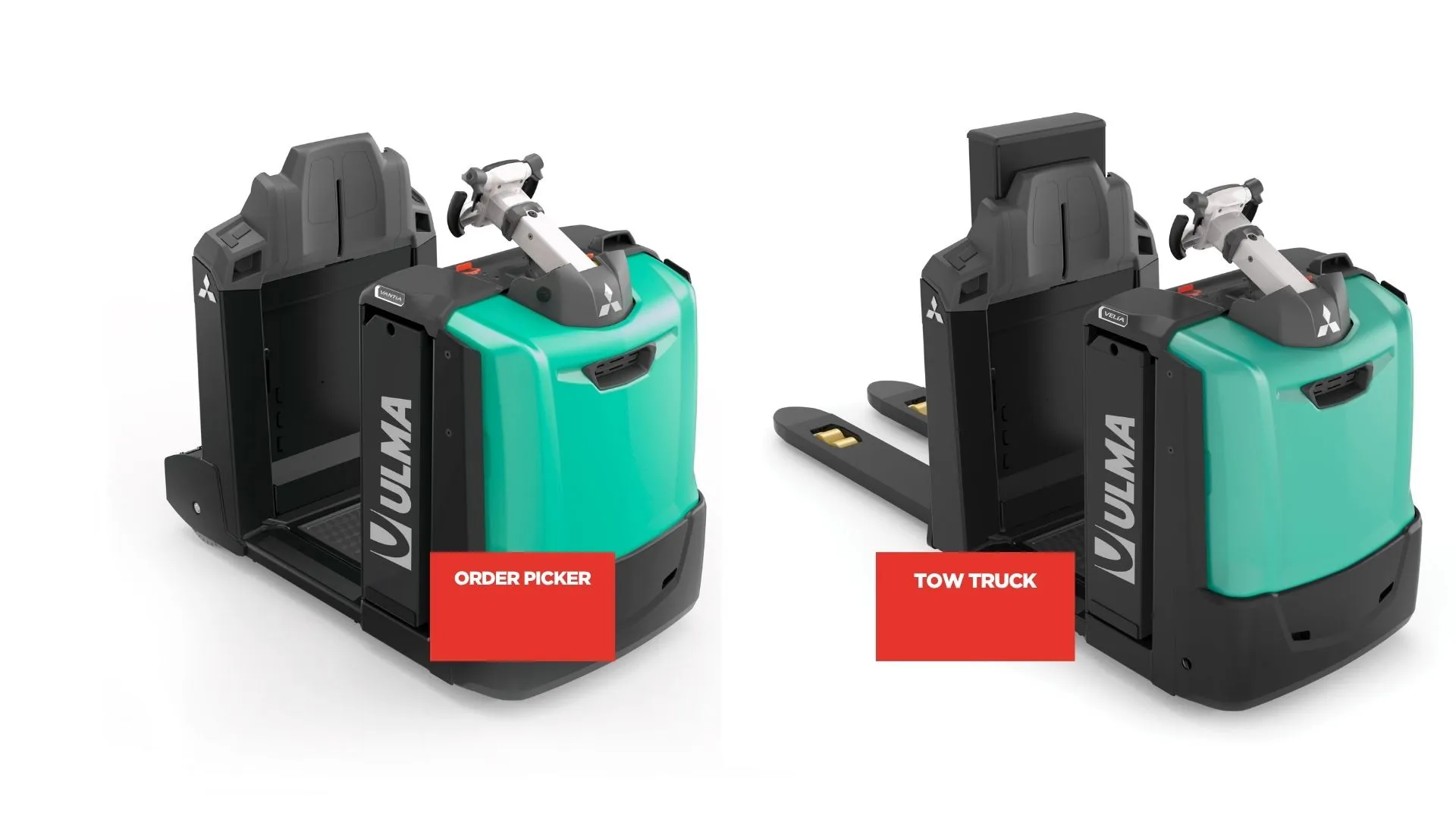
There are two types of equipment that coexist in many warehouses, but they serve very different purposes. If your operations include order picking or internal goods transport, choosing incorrectly between an order picker and a tow tractor has a direct cost in terms of time, fatigue, and productivity. This guide explains the differences and the criteria to analyze before making a decision.
Differences between an order picker and a tow tractor
Before considering the decision-making criteria, it is important to clarify the function of each.
What is an order picker and when to choose it for picking operations
An order picker is a piece of equipment designed for the operator to move through the warehouse, collecting units or boxes from different locations to complete an order. The operator travels on the equipment's platform and works directly on the shelves, without the need to get off between each pick. Low-level models work at ground level, and in some cases, they elevate the operator's platform up to 1,000 mm, allowing the first racking level to be reached effortlessly. Medium and high-level models elevate both the forks and the operator to greater heights. In the Mitsubishi range, the VELiA ES series (models OPB12 to OPB25N2) covers capacities from 1.2 t to 2.5 t with speeds of up to 13 km/h. It is available in standard configurations, with an elevating operator platform, with long forks to transport up to four roll-tainers simultaneously, and in combinations of both options. An order picker is the right equipment when the primary operation is order preparation: many SKUs, frequent travel through the warehouse, and the need to collect units or boxes at different locations throughout the shift.
What is a tow tractor and when to use it in a warehouse
A tow tractor does not elevate loads or pick individual units. Its function is different: to tow one or more loaded carts or trailers from one point to another in the warehouse or facility, forming what is known as a trailer train. It is the solution when large volumes must be moved between areas—from receiving to production, from the warehouse to shipping, from one manufacturing line to another—repetitively and efficiently. A single piece of equipment and one operator can move in one cycle what would otherwise require multiple trips with different machines. The Mitsubishi VANTiA range (models TBR30N2 and TBR50N2) offers towing capacities of 3 t and 5 t respectively, with a maximum speed of 13 km/h. It includes an optional automatic hitch, which allows the operator to couple and uncouple the trailer without leaving the platform, reducing downtime on routes with frequent stops.
How to choose between an order picker and a tow tractor
The choice does not depend on the equipment itself, but on what happens in the warehouse. There are four questions that guide the decision:
What is the work unit: the individual unit/box, or the full pallet in motion?
If the operator picks individual SKUs or boxes, you need an order picker. If moving full loads from one point to another without individual handling, the tow tractor is more efficient.
How many stops are there in each work cycle?
The order picker is optimized for frequent, short stops: pick, move, pick. The tow tractor performs better on routes with few stops and long distances between areas.
What is the distance between areas?
In warehouses or plants with long distances between loading and unloading points, the tow tractor better amortizes its cost per cycle. In medium-sized warehouses with picking aisles, the order picker is more agile.
Is there work at height?
If part of the locations is above ground level, the order picker with an elevating platform is the only option of the two. Tow tractors operate exclusively on flat surfaces.
Can order pickers and tow tractors be combined in the same warehouse?
In many facilities, the answer is not one or the other: it is both. A distribution center may need tow tractors to move the inbound flow from the dock to the storage areas, and order pickers to execute order preparation in the picking lines. They are complementary, not alternative, equipment. When designing a mixed fleet, one factor simplifies operation: sharing technology between equipment. Both the VELiA ES and VANTiA ranges incorporate the SDS (Sensitive Drive System) by Mitsubishi as standard, a software that adapts the equipment's behavior to each operator's driving style from the very first use. In practice, this means that an operator working with a VELiA ES order picker does not need specific additional training to handle a VANTiA tow tractor: the driving logic is consistent between both pieces of equipment. In environments with high staff turnover or multiple shifts, this consistency has real value. Both pieces of equipment also share the same energy efficiency: 14% lower than the closest competitor in their class, with lithium-ion battery availability as an option for continuous or multi-shift operations.
What equipment does your warehouse need? We are here to help you choose
At ULMA Lifting Solutions, we analyze your operations before recommending any equipment. If you describe how your warehouse functions—including flows, volumes, distances, and shifts—we can identify the configuration that makes the most sense and explain exactly why.
Request a no-obligation analysis of your operations
FAQs: Frequently asked questions about order pickers and tow tractors
What is the difference between an order picker and a tow tractor?
An order picker is designed for order preparation: the operator moves through the warehouse picking units or boxes at different locations. A tow tractor is designed for internal transport of large volumes: it tows one or more loaded carts between warehouse or plant areas without manipulating the load individually.
Can an order picker work at height?
Yes. Models with an elevating platform allow the operator to rise up to 1,000 mm to reach the first or second racking level without getting off the equipment. For greater heights, there are medium and high-level order pickers.
For which sectors is a tow tractor most common?
It is especially common in the automotive industry, airport logistics, hospitals, and manufacturing plants with repetitive internal supply routes. It is also common in large warehouses with long distances between zones.
Can order pickers and tow tractors be used in the same warehouse?
Yes, and it is a common combination in medium and large facilities. The tow tractor manages the inbound flow and distribution of volumes between areas; the order picker executes fine picking at the locations. They are complementary equipment.
What is Mitsubishi’s SDS system?
SDS (Sensitive Drive System) is a driving software that adapts the equipment's behavior to the style of each operator from the first touch of the controls. It adjusts the steering, acceleration, and deceleration response according to the steering angle and the speed of the operator's actions. It is available as standard on the VELiA ES and VANTiA ranges.