
V16 Beacon in Spain: Forklifts and Warehouse Operations - What You Need to Know
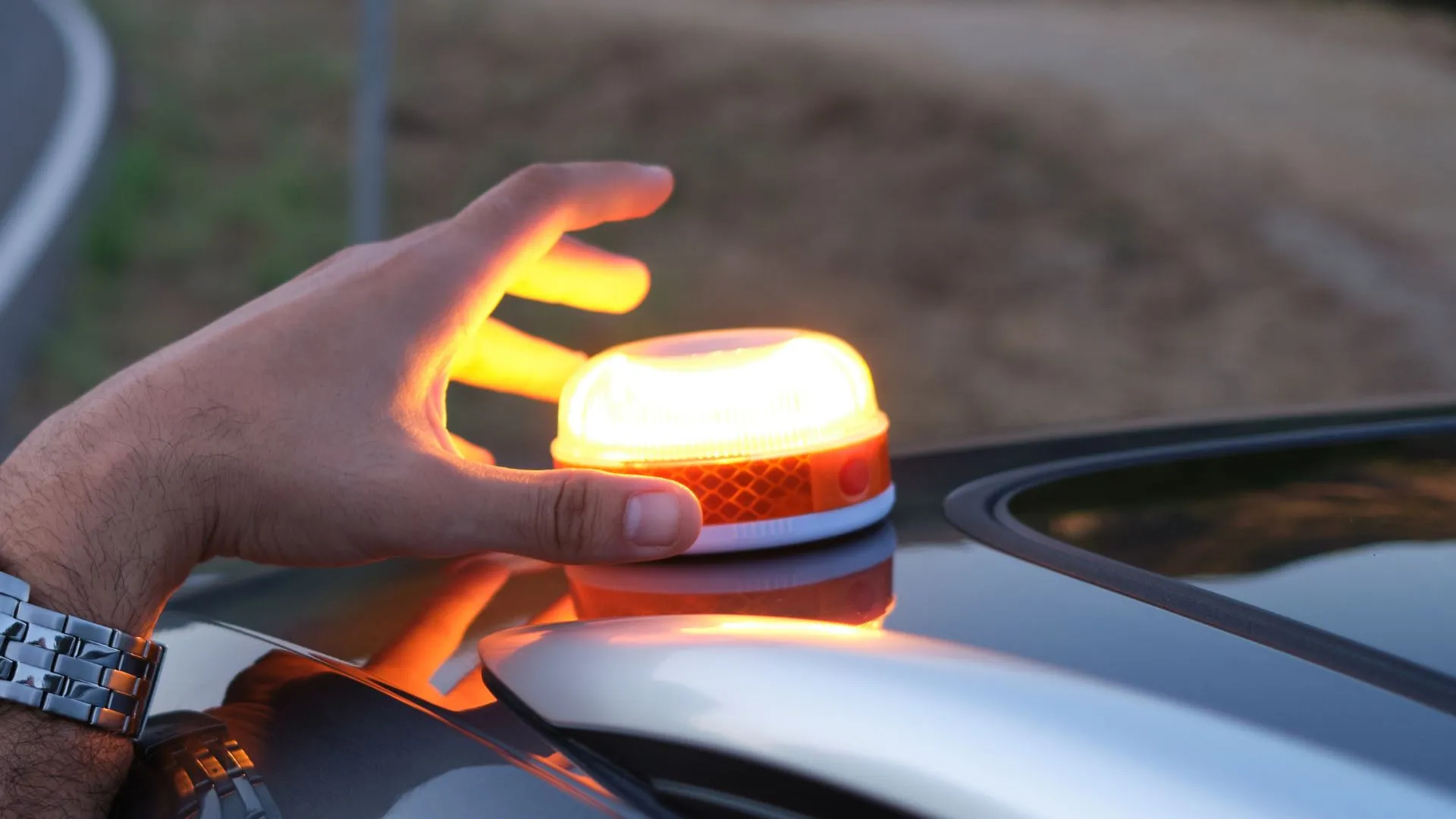
The countdown has already begun: starting 1 January 2026, the connected V16 beacon will be the only legal device for signalling breakdowns and accidents on the road. It fully replaces the traditional warning triangles.
The topic is everywhere in the media, but in logistics a very specific question arises:
What about forklifts and material-handling machinery? Do they also need to carry a V16 beacon? This article explains it all from a practical point of view: what the regulation requires, when fines apply, and what it really means for your warehouse operations.
What the Connected V16 Beacon Is and Why It Will Be Mandatory in Spain
The connected V16 beacon is a luminous emergency device placed on top of the vehicle when it becomes immobilised on the road due to a breakdown or accident. It emits a 360° flashing light visible from up to 1 km away and automatically sends the vehicle’s location to the DGT 3.0 platform — no smartphone or app required.
The purpose is clear:
To reduce the risk of collisions, since drivers will no longer need to exit their vehicles to place warning triangles.
To integrate real-time incident information into the DGT’s connected mobility platform.
When the V16 Beacon Becomes Mandatory and What Fines Apply?
The DGT (Spanish Road Safety Authority) has established the obligation in the national traffic regulation and reiterated it through official statements.:
- Key date: From 1 January 2026, the connected V16 beacon becomes the only legal device for signalling a stopped vehicle on the road.
- Warning triangles: After that date, triangles will no longer be accepted as a valid pre-signalisation tool.
- Types of vehicles generally affected:
- Passenger cars. Light and heavy industrial vehicles, buses and mixed-use vehicles and vehicles used for transporting goods
- Fines: Penalties for not carrying a valid pre-signalisation device typically range from €80 to €200, depending on the specific infringement (not signalling, using non-approved devices, etc.).
When the V16 Beacon Impacts Forklifts, Logistics and Material Handling?
Here is the part that matters if you manage a warehouse or a fleet of forklifts:
1. The DGT regulation applies only when vehicles circulate on public roads. If your forklift operates exclusively inside a warehouse, plant or private premises, traffic regulations do not apply. In that scenario, we are talking about health & safety (HSE/PRL), not road safety legislation.
2. Many registerable forklifts fall under the classification of special vehicles. Within this group, regulations distinguish different categories based on weight and maximum dimensions. In practical terms, most standard forklifts and common material-handling equipment (indoor forklifts, reach trucks, stackers, powered pallet trucks, narrow-aisle equipment, etc.) fall well below the size and weight thresholds applicable to trucks or buses.
3. This means that in many cases, these machines fall into a special-vehicle subgroup not required to carry a V16 beacon on public roads. Only exceptionally large or heavy equipment might fall into a category where the V16 becomes mandatory.
Operational conclusion: For the typical warehouse forklift, the V16 beacon is not usually mandatory under traffic regulations. But if you have equipment that circulates on public roads or is near dimensional limits, it’s important to assess each machine case by case.
Quick Checklist for Logistics and Maintenance Managers
To decide what to do with the V16 beacon in your fleet, use this practical checklist:
1. Where does each machine operate?
- Only inside the warehouse / private premises: DGT does not apply → V16 not mandatory.
- Occasional circulation on public roads (between buildings, industrial estates, etc.): check technical specs.
- Frequent road circulation: detailed assessment required.
2. What type of machine is it?
- Indoor forklifts, reach trucks, stackers, pallet trucks, very narrow aisle equipment… ➜ Normally not in the category required to carry V16.
- Large special machinery, platforms, construction or service vehicles close to truck-like dimensions. ➜ Check technical specifications and regulations carefully.
3. Do you have it documented? Even if the V16 is not mandatory for your forklifts, it is advisable to:
- Record it in internal documents (equipment sheets, procedures).
- Add a note in delivery reports or maintenance documentation stating whether the machine is fitted with a V16 beacon — and why
This protects you during:
- Inspections
- HSE/quality audits
- Investigations after an incident
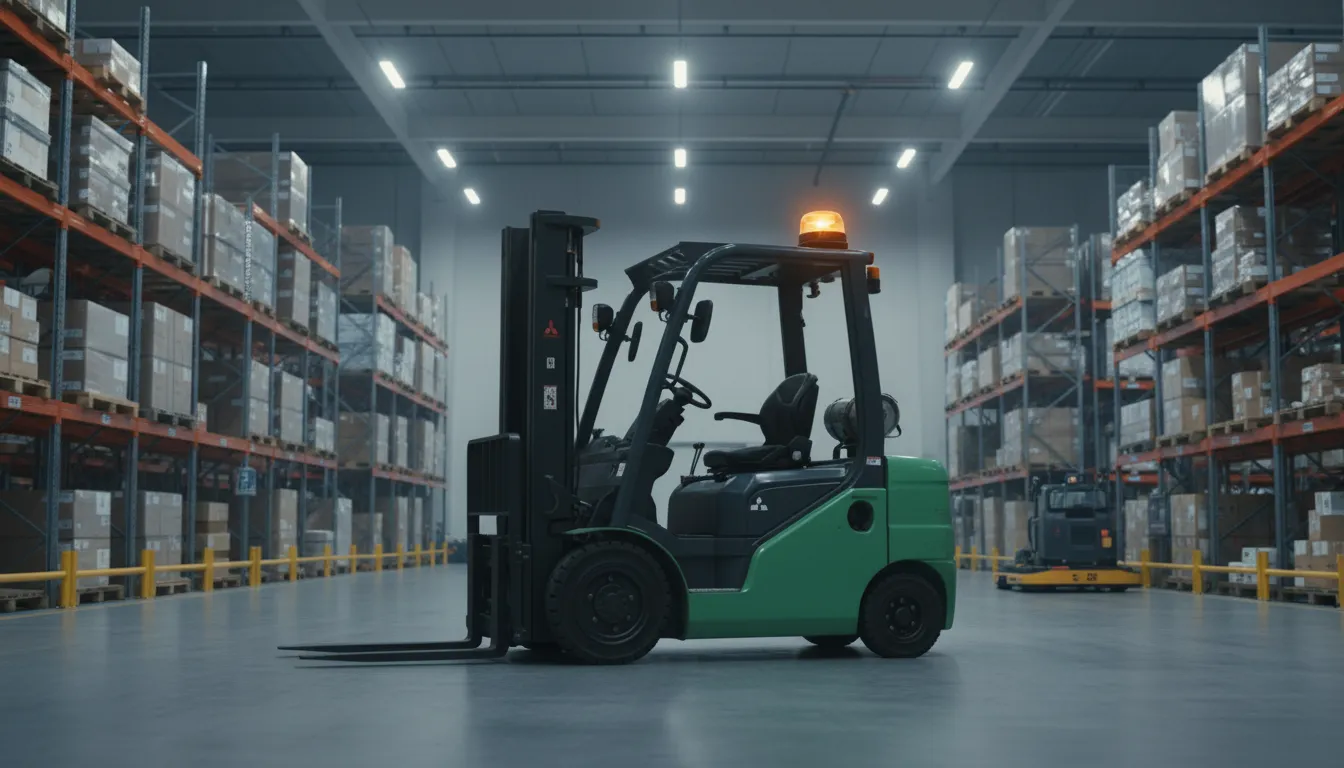
Does It Make Sense to Install a V16 Beacon on Forklift?
The legal requirement is one thing, but operational convenience is another. A V16 beacon may be advisable even when not strictly required:
- Fleets that leave the facility and circulate on open roads or between buildings
- Contracts with clients or authorities requiring additional safety measures
- Companies aiming to align internal safety protocols with emerging regulations applied to cars and trucks
In these cases, the V16 beacon becomes another safety accessory, just like amber beacons, pedestrian detection systems or 360° cameras.
Frequently Asked Questions About the V16 Beacon in Warehouses
1. Do I need to buy a V16 beacon for every forklift in the warehouse? Generally, no. If forklifts do not drive on public roads and fall outside the mandatory categories, the DGT does not require a V16. Another matter is whether you choose to install it as an internal safety measure.
2. What if my forklift crosses a public road between two buildings? This is a mixed scenario: if the crossing is considered public-road circulation, it must be analysed. Even so, many standard forklifts will still fall within non-mandatory groups — but reviewing the technical documentation is recommended
3. Can I be fined if my forklift circulates on public roads without a V16 beacon? If the forklift is in a category where V16 is required and it is not equipped with an approved device, there may be a fine — just like for cars or trucks. Hence the importance of checking each machine’s category and documenting the decision.
4. Does any “cheap” V16 beacon found online work? No. From 2026 onwards, only connected and DGT-approved V16 beacons will be valid. Using non-approved devices may result in penalties and, more importantly, safety risks.
What You Can Do Today in Your Warehouse?
With the enforcement date approaching, the most sensible steps are:
1. Take inventory: List which machines may be affected (by type and public-road use).
2. Classify by risk: No road circulation → focus on internal HSE. Occasional circulation → consider V16 as an additional safety measure. Frequent circulation → review whether V16 may be mandatory.
3. Define a company policy: Decide when the V16 beacon will be mandatory, recommended or optional within your fleet.
4. Document and train: Write everything down and train operators and maintenance staff. And if you want expert support, this is where companies like ULMA Lifting Solutions can help you: Assess your forklift fleet and material-handling equipment, define a V16 strategy adapted to your real operational risks and integrate the V16 (when required) into your maintenance and parts plan.